
the No1 Google Ranking Luxury Property Magazine

The Rise Of Residential Travel: When Luxury Travel Becomes Ownership
22.10.26In prime real estate, the pathway to secondary home acquisition has historically been governed by spreadsheets: yield projections, long-term capital preservation metrics, and currency hedges.
Yet across global resort markets, an emotional and experiential dynamic is commanding international transactions: the rise of residential travel.
Rather than searching for assets through an exclusively transactional lens, affluent buyers are transforming the destinations they first discovered on holiday into places they permanently own. Travel is no longer merely a leisure escape; it has become the primary gateway to cross-border property acquisition.
From guest to resident
The trajectory of the residential traveller follows an organic progression: discover an exceptional destination, return across successive seasons, form a deep emotional affinity, and ultimately secure private real estate.
High-net-worth buyers are fundamentally seeking to codify and preserve a lifestyle they have already tested and enjoyed firsthand:
- Owners want immediate access to the microclimate, coastal topography, and natural setting they fell in love with as visitors.
- The expectation has evolved beyond the physical walls of a villa. Buyers look to replicate the five-star amenities of their favorite boutique resorts, from private chef services and holistic wellness facilities to local gastronomy and yachting infrastructure.
- Beyond an isolated retreat, there is an appetite for integrated communities where like-minded global travellers and their families can establish multi-generational roots.
Antigua as a case study: Pearns Point and record inbound momentum
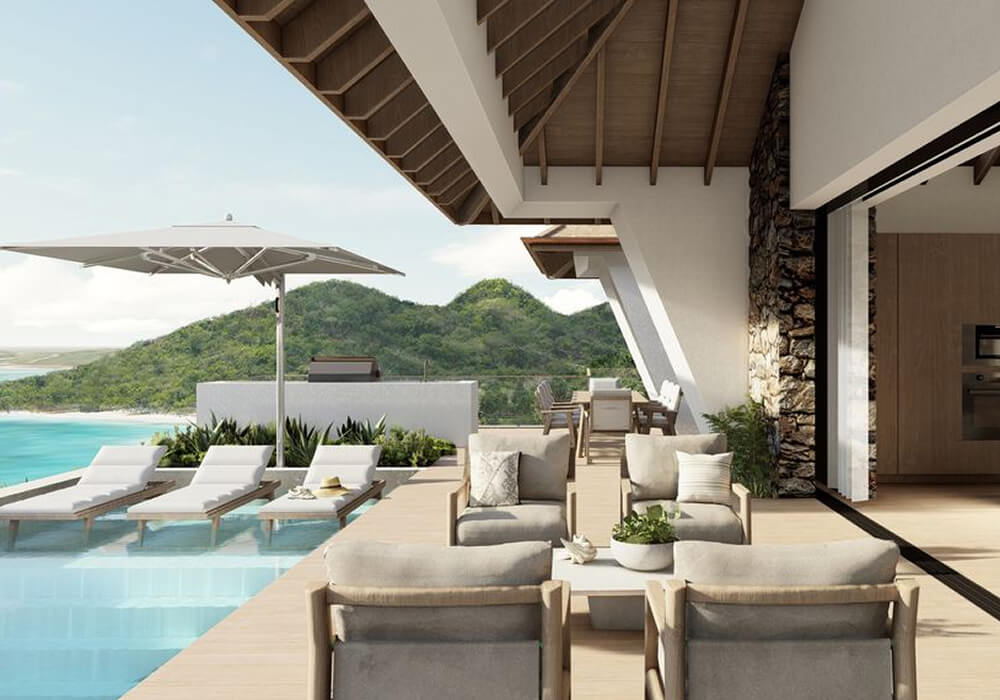
Image: Pearns Point
Nowhere is the residential travel phenomenon more visible than across the Eastern Caribbean.
In Antigua and Barbuda, tourism data demonstrates strong, sustained global demand. Official figures from the Antigua and Barbuda Tourism Authority reveal that the twin-island nation welcomed 110,832 stay-over arrivals in the first quarter of 2026—a 6.7% year-over-year increase compared to the 103,843 arrivals recorded during the same period in 2025.
This growing influx of high-spending international visitors translates into direct prime residential absorption. Developments such as Pearns Point—a secluded peninsula on Antigua’s western coast offering bespoke, low-density beachfront plots and custom villas—exemplify the model. Many prospective purchasers first encountered the island as charter yacht guests or visitors staying at five-star coastal retreats. That initial leisure experience established the foundation for permanent estate acquisition.
Global wealth allocation
This evolution carries significant implications for developers, hospitality operators, and private wealth advisors.
Five-star resorts are increasingly serving as high-conversion showrooms. When travellers experience seamless management and exceptional service, the transition toward buying a serviced residence within the same umbrella becomes a natural next step.
Buyers who purchase through residential travel arrive with deep local familiarity. They already understand the local culture, seasonality, flight logistics, and regional geography, compressing typical sales decision cycles.
Also, a home secured through residential travel acts as an emotional dividend—delivering immediate lifestyle utility while holding tangible physical real estate in high-barrier coastal enclaves.
As global mobility expands and flexible living allows high-net-worth individuals to spend extended periods away from primary urban centers, the line separating travel from residence will continue to dissolve. The ultimate souvenir of an exceptional journey is no longer a photograph, but a set of keys.

Categories
Property Of The Week
-
 Property Of The Week: $45M French Riviera Penthouse With Historic Kennedy Dynasty Ties
22.10.26
- Property Of The Week: A Botanical Grandeur At Acacia, Al Barari 12.10.26
- Property Of The Week: The Crown Duplex Penthouse At 100 George Street W1 07.10.26



Abode Affiliates
































































































































































































COPYRIGHT © Abode2 2012-2026